Ultra pace strategy by distance, 50K, 100K, 100-mile
Unlock ultra-endurance success! Discover why marathon pacing fails beyond 30km & master distance-specific strategies for 50K, 100K, 100-mile races with Ascend Fitness.
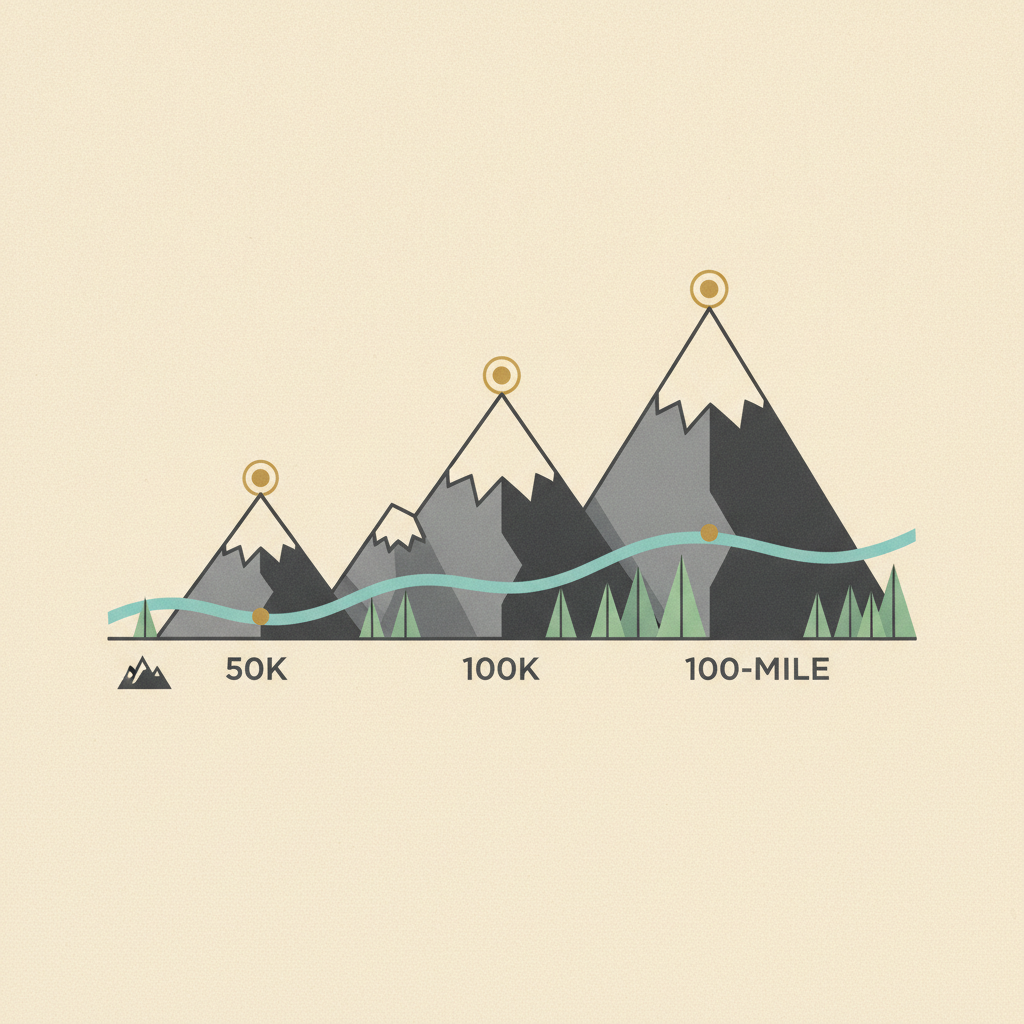
In this article
The allure of ultra-running is undeniable, but the strategies that carry you through a marathon will often betray you beyond 30 kilometres. Ultra-distances demand a fundamental shift in mindset and execution, where traditional pacing rules break down, and a nuanced approach to effort, nutrition, and even walking becomes paramount. This isn't just about going farther; it's about going smarter. For those charting their elevation on Ascend Fitness, understanding these distinctions is key to conquering your next mountain, whether it's a 50K, a 100K, or the daunting 100-mile challenge.
Beyond the Marathon: Why Ultra Pacing Demands a Different Approach
Consider the marathon a sprint compared to the ultra. In a marathon, you can often maintain a relatively consistent pace, pushing close to your lactate threshold for extended periods. This strategy is unsustainable over 50K, and downright suicidal for 100K or 100 miles. The primary reason is glycogen depletion. Your body's carbohydrate stores, even when fully topped up, are finite. Pushing too hard too early burns through these reserves at an alarming rate, leading to the infamous 'bonk', a physiological shutdown that's far more severe and prolonged in an ultra than its marathon counterpart.Moreover, the cumulative impact on muscles and connective tissues is immense. Every step, every hour, adds to the microtrauma. Attempting to run every kilometre at a 'fast' pace will inevitably lead to breakdown, injury, or a forced march of survival rather than a strategic race. Elite ultra-runners understand this implicitly. Their early miles are often deceptively slow, conserving energy for the long haul. The goal isn't to set records in the first half, but to ensure you have the capacity to finish strong in the second.
The Art of Power Hiking: Embracing the Walk from Kilometer 30
This is perhaps the most counter-intuitive yet critical rule for ultra-success: walk every significant hill from roughly kilometer 30 onwards. For longer races, this threshold might even come earlier. Why? Power hiking, when executed correctly, is significantly more energy-efficient than attempting to run steep ascents. It conserves precious glycogen, reduces muscular fatigue in your prime movers (quads, hamstrings), and offers an active recovery for your cardiovascular system.Don't mistake this for surrender. Power hiking is a skill, involving an aggressive lean into the hill, driving with your arms, and taking purposeful steps. It allows you to maintain forward momentum without skyrocketing your heart rate or depleting your energy reserves. Many experienced ultra-runners will tell you they can often cover uphill terrain just as quickly, or even quicker, by power hiking than by trying to run, all while expending less effort. This strategy is fundamental to extending your endurance window and avoiding late-race collapse.
Heart Rate Zones: Your Ultra Endurance Compass
For ultra-distances, your heart rate monitor isn't just a gadget; it's a crucial guide to sustainable effort. Forget pushing into Zone 3 or 4 for anything more than very brief bursts. The vast majority of your ultra-running should occur firmly within your aerobic zones.* 100-Mile Races: Aim to spend almost all of your time in Zone 1. This is conversational pace, where you can easily hold a full conversation without gasping. Any excursions into Zone 2 should be brief and infrequent, typically on flatter sections or gentle downhills. The goal is to keep your body burning fat as its primary fuel source, sparing your limited glycogen stores. * 100K Races: Your ceiling is generally Zone 2. You can push into the lower end of Zone 2 on runnable sections, but be vigilant. If your heart rate creeps into the mid-to-upper Zone 2 for extended periods, you're likely overexerting. * 50K Races: While still an ultra, a 50K allows for slightly higher intensity. You might spend more time in Zone 2, possibly touching Zone 3 on harder efforts, but always with the understanding that you're operating on a different scale than a marathon (Koop, 2020).
Consistently monitoring your HR ensures you're running your own race, not someone else's, and critically, that you're running within your physiological means for the distance.
Mastering the Aid Station: More Than Just a Pit Stop
Aid stations are strategic hubs, not mere refuelling points. Your approach to them can significantly impact your race outcome. The key is efficiency and purpose.* Be Prepared: Know what you need before you arrive. Water bottles, nutrition, any gear adjustments. * Refuel & Rehydrate: Prioritise calories and fluids. Ultra-runners often underestimate their caloric needs, leading to energy deficits. Aim for roughly 200-300 kcal per hour, but this is highly individual and depends on race intensity and conditions. Don't rely solely on what's offered; carry your preferred nutrition. * Address Issues Promptly: Blisters? Chafing? Stomach issues? Tackle them at the aid station. A small problem left unchecked can quickly become race-ending. * Time Management: Lingering is your enemy. While a brief mental break is fine, aim for swift transitions. The minutes lost at multiple aid stations add up significantly over 100 kilometres (iRunFar interviews frequently highlight this principle among elites).
Think of aid stations as pit stops in a Formula 1 race: precise, fast, and critical for performance.
Ascend Fitness: Your Adaptive Ultra Strategist
Navigating the complexities of ultra-pacing, nutrition, and hydration can feel like a full-time job. This is where Ascend Fitness steps in as your intelligent training partner. Our unique gamified platform maps your workouts, nutrition, water intake, and steps to elevation on real mountains, providing a tangible sense of progress.Ascend's advanced pace calculator doesn't just apply marathon logic; it understands the nuanced demands of ultra-distances. It helps you define a sustainable pace strategy tailored to your chosen race distance, factoring in elevation profiles and your personal fitness data. Furthermore, our adaptive macros feature adjusts your caloric and macronutrient recommendations in real-time, ensuring you meet the immense kcal demands of ultra-training and racing. No more guesswork or generic diet plans – just precise, distance-specific guidance to fuel your ascent.
Tailored Pacing: A Distance-Specific Blueprint
Here's a quick overview of how your strategy should adapt across popular ultra distances:
| Strategy Aspect | 50K Ultra | 100K Ultra | 100-Mile Ultra |
|---|---|---|---|
| Pacing Intensity | Moderate-high Zone 2, occasional Zone 3. | Low-moderate Zone 2, minimal Zone 3. | Predominantly Zone 1, brief low Zone 2. |
| Walking Strategy | Walk steep hills from ~KM 30. | Walk all significant hills from ~KM 20-25. | Walk almost all hills, power walk flats/down. |
| Aid Station Focus | Efficient refuel/rehydrate. | Longer stops for solid food, problem-solve. | Comprehensive pit stops, full reset. |
| Nutrition Needs | Consistent carbs, electrolytes. | Higher total kcal, varied sources, sodium. | Max kcal, highly varied, focus on gut health. |
| Mental Game | Push through discomfort. | Manage fatigue, stay positive. | Extreme resilience, embrace the grind. |
Ready to redefine your limits and conquer the world's most iconic peaks from your own backyard? Ascend Fitness provides the tools, guidance, and motivation to transform your ultra ambitions into reality. Start your ascent today and experience fitness gamified. Join the waitlist
FAQ
Common questions
Why doesn't marathon pacing work for ultras?
Marathon pacing relies on holding close to lactate threshold, which burns finite glycogen too quickly over ultra distances and triggers a far more severe bonk, while hours of impact compound muscle and connective-tissue damage. Beyond roughly 30km, effort, fuelling and walking all need rethinking.
How should pacing change between 50K, 100K and 100-mile races?
A 50K can be run closer to a sustained hard effort, but 100K and especially 100-mile races require markedly more conservative early pacing, planned walking on climbs, and continuous fuelling to avoid glycogen depletion. The longer the race, the more the early kilometres should feel easy.

Sam Wilson
Founder of Ascend Fitness. Building a gamified fitness tracker from Christchurch, NZ. Lifts, runs, and writes about both.
Start the climb
Turn today's read into tomorrow's first log.
Ascend Fitness is in private beta. Join the waitlist, early climbers jump the TestFlight queue and get a heads-up the day it drops.